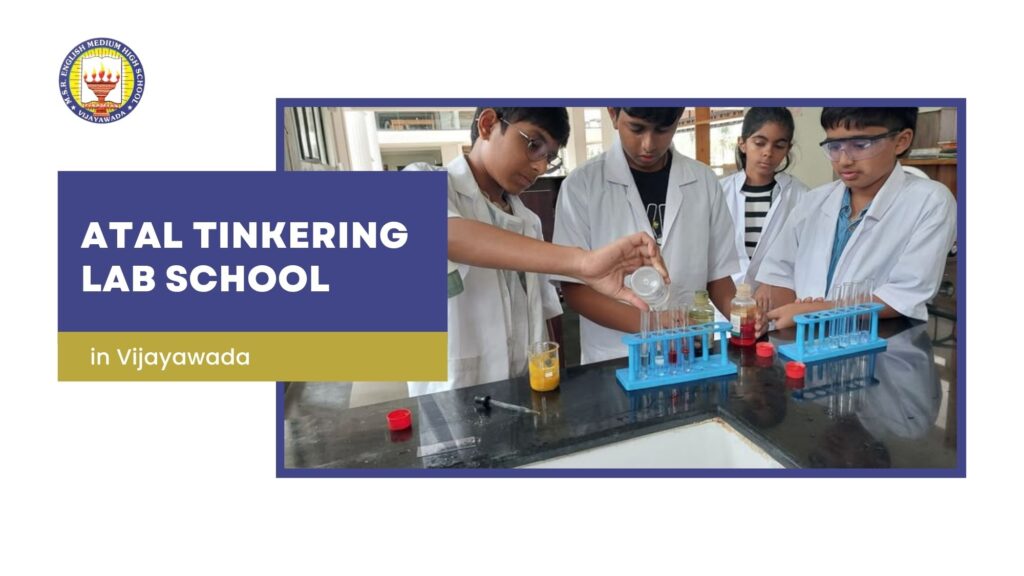
Every parent in Vijayawada has heard the phrase "future-ready education" thrown around in school brochures. But very few schools can actually show you a room where that future is being built by 12-year-olds with screwdrivers and sensors in their hands. That room is called an Atal Tinkering Lab, and it is quietly becoming one of the biggest differentiators between an ordinary school and a genuinely innovative one.
If you have searched for atal tinkering lab school vijayawada while shortlisting schools for your child, you are asking the right question at the right time. This blog breaks down what an ATL actually is, why it matters for your child's brain development and career readiness, how MSR English Medium High School (Maddi Subba Rao) built one of the most active ATLs in Vijayawada, and how it compares to what other schools in the city currently offer.
What Is an Atal Tinkering Lab?
An Atal Tinkering Lab is a government-funded innovation workspace inside a school, set up under the Atal Innovation Mission, NITI Aayog, to teach students grades 6 to 12 how to design, build, and problem-solve using real tools and technology.
Launched in 2016, the Atal Innovation Mission has established over 10,000 ATLs across 722+ districts in India, with the recently approved AIM 2.0 extending the mission's budget to Rs. 2,750 crore through 2028. Each lab is typically equipped with 3D printers, robotics kits, Internet of Things (IoT) modules, microcontrollers like Arduino, and rapid prototyping tools — essentially a mini innovation studio inside a school building.
Why Does an Atal Tinkering Lab School in Vijayawada Matter for Your Child?
An atal tinkering lab school vijayawada matters because it moves your child from memorising answers to designing solutions — a skill no textbook alone can teach. It builds scientific temperament, computational thinking, and confidence years before college.
Here's the part most brochures skip: Indian classrooms have traditionally rewarded recall. ATLs flip that model. A student in an ATL doesn't just learn what a circuit is — they build one, test it, watch it fail, and fix it. That loop of building, failing, and iterating is exactly what NEP 2020 asks schools to cultivate, and exactly what top engineering and design colleges now look for in an applicant's profile.
Why this matters practically for parents:
- Early, hands-on exposure to robotics, coding, and electronics reduces the intimidation factor before Class 11 science streams begin
- National-level innovation challenges run through ATLs give students real competition exposure and certificates that strengthen college applications
- Group-based tinkering projects build teamwork and communication alongside technical skill
- It gives your child a genuine head start in STEM, robotics, and AI-adjacent careers
How Does MSR's Atal Tinkering Lab Work in Practice?
MSR's ATL runs on a mentor-led model where select students of Classes VI, VII, and VIII are trained by industry partners on real hardware, not just worksheets. The lab has run under a national "Women in Science" theme with direct corporate mentorship — a rare feature among Vijayawada schools.
MSR x Dell: The Women in Science Program
During the 2020-2021 cycle, the Government of India selected "Women in Science" as the national ATL theme, and Dell partnered directly with MSR school Vijayawada to train 30 girl students across Classes VI, VII, and VIII. This wasn't a one-off workshop — it was a structured, multi-year mentorship where students developed a scientific temperament and innovative thinking, with top project teams eligible for national-level financial assistance from the expert evaluation committee.
A Quick Snapshot of MSR's ATL Journey
Feature
Detail
Theme
"Women in Science" (Government of India, AIM)
A Quick Snapshot of MSR's ATL Journey
| Feature | Detail |
|---|---|
| Program launched | 2020–2021 national ATL cycle |
| Theme | "Women in Science" (Government of India, AIM) |
| Industry Partner | Dell |
| Beneficiaries | 30 girl students, Classes VI–VIII |
| Tools used | Robotics kits, sensors, microcontrollers, prototyping tools |
| Outcome | National-level project funding eligibility for top teams |
| School legacy | Operating since 1991, CBSE-recognised, 1100+ students |
What Mistakes Do Parents Make When Evaluating an ATL School?
The most common mistake is assuming every school with an "ATL board" outside the lab room is running an active, well-mentored program. A lab full of unused kits is not the same as a lab producing real student projects.
⚠️ Common Mistakes to Avoid:
- ❌ Assuming ATL = a computer lab with extra gadgets (it's project-based, not screen-based)
- ❌ Not asking how many students actually get lab access per year
- ❌ Ignoring whether the school has industry mentorship (Dell, Avishkaar, Blix, etc.) versus just equipment
- ❌ Overlooking whether ATL projects connect to national competitions or stay confined to the classroom
- ❌ Focusing only on infrastructure and skipping questions about teacher training for the lab
How Does MSR Compare to Other ATL Schools in Vijayawada?
Vijayawada now has a handful of schools running Atal Tinkering Labs, but the depth of mentorship, corporate partnerships, and student outcomes vary sharply between them. MSR stands out for its corporate-backed, theme-based national program rather than a generic equipment setup.
How Does MSR Compare to Other ATL Schools in Vijayawada?
| School | ATL Highlight | Industry/Kit Partner |
|---|---|---|
| MSR English Medium High School, Kothapet | National "Women in Science" theme, corporate-mentored, 30 students trained directly | Dell |
| Aravinda High School & CBSE School, Kunchanapalli | Advanced ATL setup for robotics and electronics | Avishkaar, Blix, Mechanix |
| Don Bosco School, Gurunanak Colony | ATL plus 3D modelling and Arduino coding | In-house |
| NSM Public School | Robotics-focused hands-on learning | Blix |
| AIMEE International School | Coding, automation, electronics exposure | Avishkaar |
School
ATL Highlight
Industry/Kit Partner
MSR English Medium High School, Kothapet
National "Women in Science" theme, corporate-mentored, 30 students trained directly
Where MSR Pulls Ahead
While competitor schools focus largely on kit-based robotics exposure, MSR school Vijayawada distinguishes itself with a mentorship-driven, gender-inclusive national program that connects directly to Atal Innovation Mission funding pathways — not just classroom activity.
What Skills Does a Child Actually Gain From an ATL Program?
A child in a well-run ATL gains applied science skills — but more importantly, they gain the confidence to attempt something they don't already know how to do. That confidence is the real long-term outcome parents underestimate.
Skills checklist your child builds through ATL:
- ✅ Scientific temperament and structured problem-solving
- ✅ Hands-on exposure to robotics, sensors, and microcontrollers
- ✅ Prototyping and iterative design thinking
- ✅ Teamwork on multi-student innovation projects
- ✅ Presentation and pitching skills for national evaluation panels
- ✅ Early orientation toward STEM, robotics, and AI career paths
Why "AI Matchmaking" Is the Smarter Way to Shortlist
This is also where AI Matchmaking in school selection becomes genuinely useful for parents. Instead of comparing brochures manually, AI-based tools can now match a child's interests — say, robotics, coding, or design — against which nearby schools actually run active, outcome-driven labs rather than passive ones. For a city with 8+ schools now claiming ATL status, that kind of matching saves parents from guesswork.
Is Vijayawada Becoming a STEM Education Hub Because of ATLs?
Yes — the rapid spread of Atal Tinkering Labs across Vijayawada schools over the last five years signals a genuine shift toward STEM-first education in the city, not just a marketing trend. Multiple schools adopting robotics kits simultaneously is a strong regional indicator.
Parents comparing options should look past the label and ask direct questions: How many students get hands-on lab time each year? Is there an industry partner involved, or only classroom equipment? Has the school produced any AIM-recognised or nationally funded student project? These three questions separate a genuinely transformative ATL from a showroom display.
How Do You Enrol Your Child at MSR's ATL Program?
Enrolment into MSR's Atal Tinkering Lab track happens through regular school admission, followed by selection into ATL batches for Classes VI to VIII based on interest and aptitude. Parents should start with a school visit and an academics conversation.
For families actively comparing every atal tinkering lab school vijayawada has to offer, the fastest way to judge fit is a direct campus conversation rather than another brochure.
Steps to get started:
- Visit MSR's Academics page to understand the full curriculum structure alongside ATL
- Download the School Readiness Checklist to see if your child's current stage aligns with admission requirements
- Reach out via the Contact Us page to schedule a campus visit
- Ask specifically about current ATL batch availability for your child's grade
MSR's CBSE academic track runs alongside the ATL schedule, so tinkering time never competes with core subject learning — see the Academics page for how the two are timetabled together.
Conclusion: Why MSR's ATL Is Worth Your Attention
Choosing an atal tinkering lab school vijayawada is no longer a "nice-to-have" decision — it's a decision about whether your child spends their most curious years building things or just reading about them. MSR's track record — a corporate-mentored, national-theme ATL program running since 2020, backed by a CBSE-recognised school with over three decades of history — puts it in a distinct category among Vijayawada's ATL schools.
This blog is brought to you in partnership with Prime Shark Ventures, helping Vijayawada schools like MSR communicate what genuinely sets their programs apart — through content that's researched, honest, and built for parents who want more than a glossy brochure.
Frequently Asked Questions
1. What is an Atal Tinkering Lab in simple terms?+
** It's a government-funded innovation lab inside a school where students in Classes 6–12 use tools like 3D printers, robotics kits, and IoT devices to design and build real projects, instead of only studying theory.
2. Which schools in Vijayawada have an Atal Tinkering Lab?+
** MSR English Medium High School (Kothapet), Aravinda High School & CBSE School, Don Bosco School, NSM Public School, and AIMEE International School are among the Vijayawada schools currently running ATL programs.
3. Is MSR's ATL open to all students?+
** ATL batches are typically selected from Classes VI, VII, and VIII based on interest and aptitude; interested parents should confirm current batch availability directly through the Contact Us page.
4. Does ATL help with career choices later, like engineering or medicine?+
** Yes — early exposure to scientific thinking, robotics, and prototyping builds a strong foundation for STEM streams, engineering, and technology-focused careers in Classes 11 and 12 and beyond.
5. What makes MSR's ATL different from other Vijayawada schools?+
** MSR ran a corporate-mentored national theme ("Women in Science") with Dell as an industry partner, training 30 girl students directly — a mentorship depth most competitor ATLs in the city do not currently offer.
6. Is Atal Tinkering Lab only for science-focused students?+
** No. ATL activities also build teamwork, communication, and presentation skills, making it valuable for students across interests, not just those planning a pure science career.
7. How much does it cost for a school to run an ATL?+
** ATLs are funded through the Atal Innovation Mission with government grants (up to Rs. 20 Lakhs per lab); the cost to parents is typically included within the school's regular fee structure, not charged separately.
8. Does MSR offer other extracurricular programs alongside ATL?+
** Yes — MSR also runs Karate, Yoga, Classical Dance, Music, and Drawing programs; see the full list on the Academics page.
9. How do I know if MSR is the right fit for my child compared to other ATL schools?+
** Compare industry mentorship, batch sizes, and past project outcomes — not just equipment lists. Visiting the campus and speaking with MSR's admissions team is the most reliable way to judge fit.
10. How do I schedule a visit to see MSR's Atal Tinkering Lab?+
** You can call the school directly at 0866-2565718, email msremhighschool@gmail.com, or submit an enquiry through the Contact Us page.